This article was prepared by the Kinmory team, which owns Trwaly. We share practical advice for a family archive and explain how our service can help preserve memories.
Introduction
A Polish family history can begin with one album, a few captions and one conversation. You do not need every date or a full biography: a note on who is pictured and why the moment mattered helps the next generation.
After a loss, looking through photographs can be hard. Take on only what you feel able to, and stop whenever you need to. Our guide to living through grief may help. You can also begin without a bereavement, to sort old albums and preserve older relatives’ stories for children.
This guide is for families in Poland, English speakers living there and people with Polish roots abroad. The records, archives and customs described are Polish. It covers what to gather, how to label old family photos, make copies and find records, and how to agree on access.
A Polish family history: what to record
Keep materials with names, dates, family relationships and sources. Recorded stories and everyday details bring people to life. Mark what is confirmed and what still needs checking.
| What to keep | How to do it | How it helps the family |
|---|---|---|
| Photographs and writing on the back | Copy both sides, add names, place and date | A way to recognise people and events |
| Conversations with older relatives | Record with consent, noting who is speaking and the date | Their voice and first-hand accounts |
| Letters, diaries, documents | Keep originals and copies, store private papers separately | Loved ones’ own words and everyday life |
| Names and family relationships | Sketch a family tree on paper, noting sources and anything uncertain | Visible links between generations |
| Family stories, recipes, sayings | Note who told them and on what occasion | A sense of loved ones’ character and lives |
| A description of the archive | List the folders, their numbers and locations | Finding things without help |
Write different versions of a name side by side: a pet name, a form used in another language or country, and a maiden name. There is no need to ‘correct’ them on a hunch, because a discrepancy can show where to look next. Mark an uncertain date ‘c.’ (circa) rather than leaving it out.
Put together a separate selection to show to other people. Leave out addresses, phone numbers, health information and photographs of living children. If a relative would rather not talk about a particular time in their life, the family history can do without it.
How to write a family history step by step
Keep the photographs in album order and identify people before making copies. Note your sources. Ask separately for consent to record a conversation and to share the recording.
1. Choose a small part of the archive
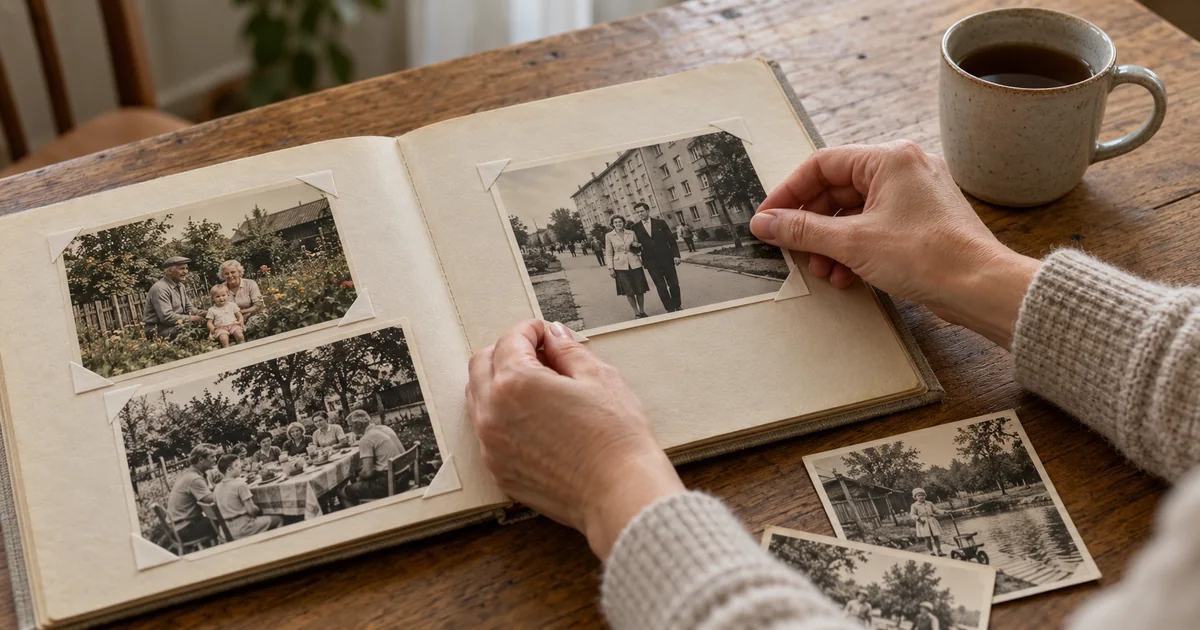
Choose one album or envelope. Photograph the pages before removing prints: their sequence can reveal connections. Number the photographs, for example ‘album A, photo 01’. Leave glued-in prints attached and ask a specialist about copying fragile or damaged material.
2. Talk to older relatives
Prepare a few specific questions: who is in the photograph, where the house stood, what the grandparents did for a living, which songs were sung at the table. Ask beforehand whether you may record the conversation and who may listen to it. There is no need to press for an answer. Repeat unfamiliar names and places back to check you heard them correctly.
3. Label the photographs
For each photograph, note who is in it (left to right), where and when it was taken. Add the source: ‘according to…’ with the storyteller’s name, or the name of a document. Avoid writing in pen on the front of a print. A soft pencil on the back or a separate numbered list is enough.
4. Make digital copies
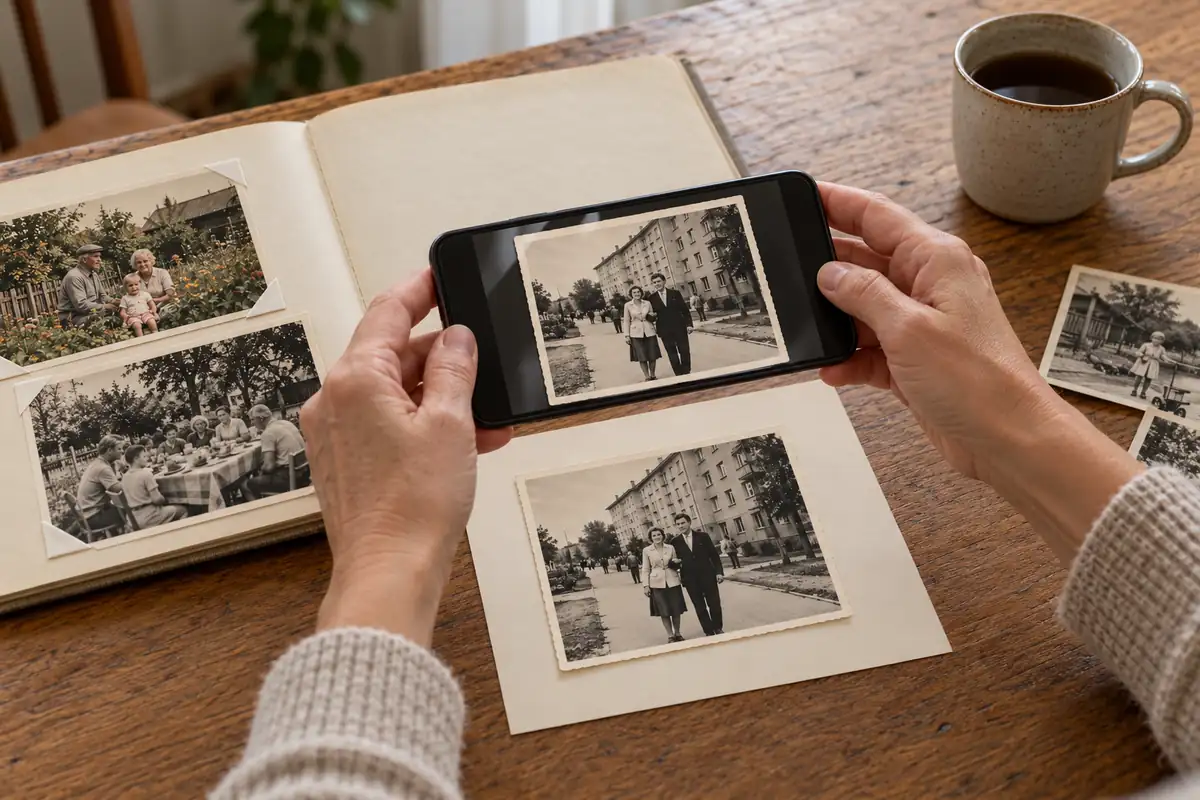
Digitising old photographs needs no special equipment. Flat, undamaged prints can be scanned or, without a scanner, photographed with a phone held parallel to the print, in even light, with no glare or shadow from your hands. Capture the whole print, edges included, and the back if there is writing on it. Check that small faces and text are legible. Leave the original file uncropped and save any corrected version separately.
5. Write the life story and draw a family tree on paper
A family tree is easiest to draw starting with yourself: add your parents, then grandparents and earlier generations, noting beside each person where the information came from. A life story can be longer than the few sentences of an obituary or klepsydra (the printed Polish death notice): home, work, house moves, favourite sayings. Write in date order or by theme.
6. Look after the copies and agree on access
Agree who keeps originals and copies and adds captions. Ask the living people concerned for consent before publishing. Have a relative find one photograph unaided to reveal unclear folder names or missing descriptions.
Family history in Poland: names, records and family gatherings
In Poland, family history can draw on remembrance customs, civil records and stories from family gatherings. Organise it so relatives abroad can contribute too.
Names. Wypominki are a Catholic custom kept by some families: the names of loved ones who have died are written on slips of paper and read out in church or at the cemetery. In some regions they are called wymienianki (Archdiocese of Kraków). Our article on Wszystkich Świętych (All Saints’ Day, 1 November) and All Souls’ Day explains how to hand in names at a parish. Secular families and those of other faiths can open the family history with their own list of names and a short note on each person.
Records. Polish birth records are kept by the USC (Urząd Stanu Cywilnego, the civil registry office) for 100 years, and marriage and death records for 80 years, counted from the end of the year they were drawn up. After that, the office transfers them to the relevant state archive within two years. The birth or marriage record of a person who outlives its retention period stays at the office until their death is registered (Article 28 of the Civil Status Records Act). An odpis (certified copy) is issued to, among others, the person concerned, their spouse, direct ancestors (such as parents and grandparents), direct descendants (including grandchildren and great-grandchildren), siblings and anyone who can show a legal interest (Article 45). Our death certificate guide explains the types of copy.
Archives. Older records are made available by the state archives. The Szukaj w Archiwach (Search the Archives) portal, developed by the National Digital Archive (Narodowe Archiwum Cyfrowe), holds descriptions and scans of archival material, and data from PRADZIAD, a database of genealogical records in the state archives. It can be used from home, so relatives abroad can help too.
Gatherings. Family stories often resurface at festive meals, name-day celebrations (imieniny), Sunday lunches or at the family działka (allotment garden). Afterwards, note who told which story and about whom. Relatives abroad can add memories during a video call.
Where to keep a family archive
Keep a family archive in two separate places. An album or memorial page is convenient for browsing, while original files let you print photographs and make further copies.
| Format | Who has access | What it is useful for | How to keep it safe |
|---|---|---|---|
| Paper album | The family and guests it is shown to | Browsing photographs and captions together | Digitise the photographs, keep the album somewhere dry |
| Files on a home drive | The owner and anyone given a copy | Keeping original photographs, recordings and documents | Make a second copy on another device |
| Shared family drive | People given permission | Collecting material from relatives in other towns and countries | Agree folder names and access, make a backup |
| Social media profile | The audience chosen in the settings | Sharing individual memories | Keep original photographs in the family archive |
| A separate memorial page | Visitors, depending on the access mode | Combining photographs, a life story and loved ones’ memories | Keep the source files, agree access with the family |
Save the second copy on another device or give it to a trusted relative. A file called ‘How to use this archive’ also helps: it explains the numbering and captions, flags any private material and names the person who looks after the archive. If you are wondering how to store old photos safely, keep them somewhere dry and shaded, away from radiators. Occasionally open a few files and ask a relative to check their access.
Your own story: what to prepare for your family
Choose photographs and describe a few events from your own life. Notes about childhood, work or hobbies are valuable without a full biography. Label recent photographs too: what seems obvious now may puzzle the next generation. Mark private material clearly.
Use any quiet moment to agree on access with your family. Give a trusted person the agreed files and an explanation of the archive.
How Kinmory works
Self-promotion. This section presents our own service, Kinmory, which owns Trwaly. Contact: info@kinmory.com.
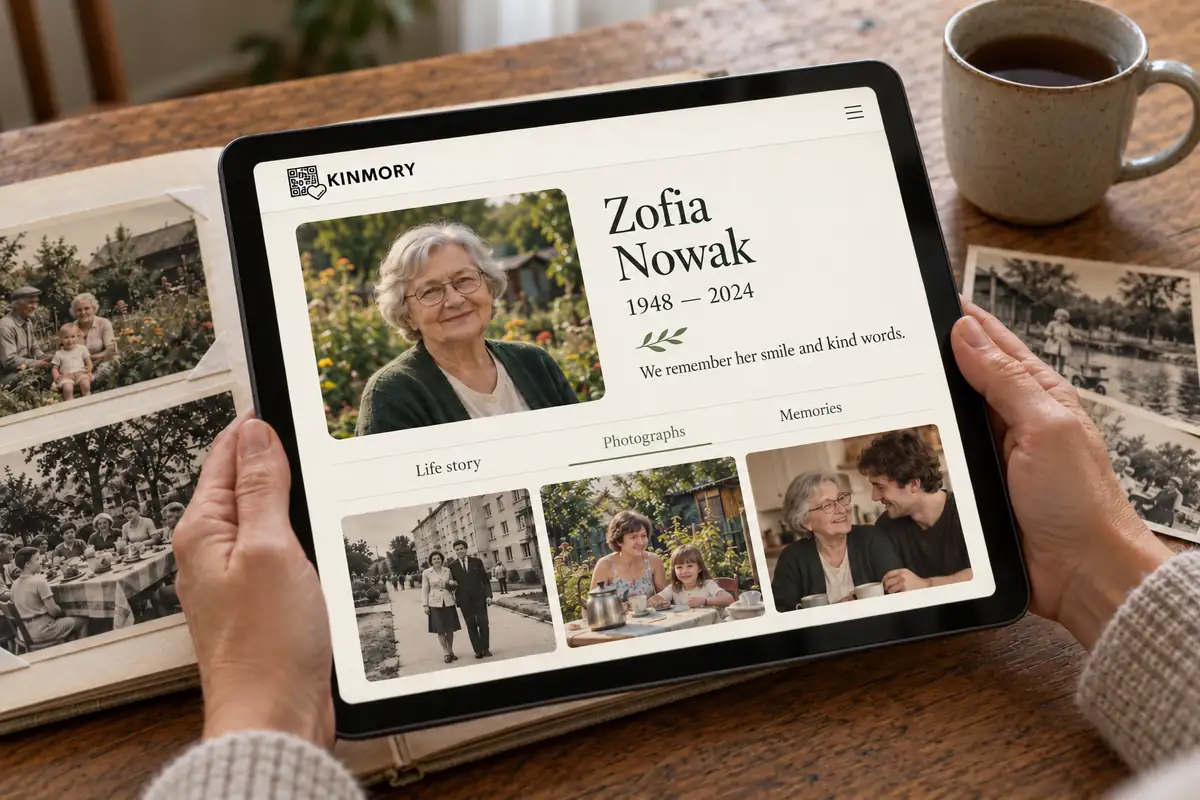
Kinmory lets you share a loved one’s portrait, captioned photographs and life story on a memorial page. A QR code connects it to a plaque at a grave or another place of remembrance. Explore the service on its home page.
We plan to add pages about your own life, separate photo albums, family trees and memoirs, bringing together loved ones’ memories and your own story for future generations.
Creating and designing the page
Begin with a few photographs and one memory of a trip, pastime or ordinary day together. The wizard guides you through the details, story and design, with a preview before publication.
Choose a design that suits how the family remembers the person, and add your own words: a family saying, a line from a favourite poem or a short dedication. Agree with your relatives on the photographs and information to publish.
The guestbook lets family and friends add memories from different stages of the person’s life and words of support. Choose whether to enable it when creating the page.
Access and help from relatives
Choose public access, a password or private access for invited guests. The wizard starts in private mode. Check the settings before publishing: public pages may appear in search results.
Public and password-protected pages are moderated before visitors can see them, and again after edits or switching to these modes. Share the link or QR code once moderation is complete.
After publication, invite relatives by email or link. Collaborative editing depends on the plan. Each invitee uses their own account to view a private page or edit it. Accepted invitations remain valid, so invite people you trust. The creator remains the owner.
The QR code and a memorial plaque
The page’s QR code can go on a plaque on the headstone or at another place of remembrance. By scanning it with a phone, loved ones can see the photographs and read the life story. After publication, you can download the code as an image to use for the plaque. The options for making, ordering and receiving the plaque can be discussed with the Kinmory team.
For viewing at the graveside, choose public mode or password-protected access. Before the plaque is made, check the code with a phone and ask for a test print. Keep the page address unchanged so the printed code still leads to it, and, after an edit, wait for moderation to finish.
Adding to the page and keeping the originals
The page has no set expiry date. Add photographs, captions and stories gradually, keeping the originals in two separate places for printed albums or your family history.
Match the plan to your collection: the number of photographs, whether you want to add videos and whether relatives will help fill in the page. Voice recordings and documents can stay in the family archive, while the material the family has agreed on goes on the page. You pay only when you publish, so you can prepare and preview the page first.
You can explore the service on the Kinmory website and then, at your own pace, choose the photographs and memories your loved one’s memorial page will begin with.
Frequently asked questions
How do you label old family photos if no one knows who is in them?
Start with the people and places someone recognises, and show the photographs to older relatives and to people in other branches of the family. Any writing on the back, a photographer’s studio stamp, clothes and buildings in the background, and comparison with dated photographs can all help. Mark anything uncertain with the word ‘probably’ and an approximate date with ‘c.’ (circa), rather than leaving a blank.
Can you publish photographs and letters of someone who has died?
In Poland, publishing someone’s image requires their permission, and claims cannot be pursued once 20 years have passed since their death. For 20 years after a death, publishing letters addressed to the deceased requires the consent of their spouse or, failing that, their descendants, parents or siblings in turn, unless the deceased stated otherwise (Articles 81–83 of the Copyright Act). Letters they wrote may be protected by copyright. Talk to close family first, and keep anything disputed or doubtful at home.
How do you keep a family history when relatives live in different countries?
Agree on a shared folder structure and a consistent way of naming files, for example by year, place and names. Captions can be written in two languages, such as Polish and English, with different versions of names recorded side by side. Each branch of the family can keep its own copy. It helps to caption photographs together at gatherings or on video calls, when older relatives can explain straight away who is in them.
How do you look after a memorial page and family materials?
A memorial page on Kinmory has no set expiry date and can be added to gradually with photographs and memories. Keep the original photographs, captions and texts in the family archive as well, in two separate places. That way the materials are at hand when the family wants to print an album, put together a family history or share memories with children.
Who can see the memorial page?
On Kinmory, the family chooses between public mode, password-protected access and private mode, in which only invited guests signed in to their own accounts can view the page. Public and password-protected pages are moderated before visitors can see them, and again after an edit or a switch to one of these modes. The page opens from a link or QR code only once moderation is complete. A public page may appear in search engine results.
Summary
Three steps are enough to begin:
- caption a few photographs from one album or envelope
- record one conversation with an older relative, if they agree
- make a second copy of the materials and check that the copy opens
Let the family history grow at your own pace. You need not fill every gap or publish what you gather.
Sources
- Archdiocese of Kraków (Archidiecezja Krakowska), 2 November 2021 — wypominki.
- Civil Status Records Act (Prawo o aktach stanu cywilnego), Journal of Laws (Dz.U.) 2026, item 393 — Articles 28 and 45: retention of records and copies.
- National Digital Archive (Narodowe Archiwum Cyfrowe): Szukaj w Archiwach — descriptions and scans of archival material, the PRADZIAD database.
- Act on Copyright and Related Rights (Ustawa o prawie autorskim i prawach pokrewnych), Dz.U. 2025, item 24 — Articles 81–83: image and correspondence.
Information about Kinmory was prepared by our team, which also runs Trwaly. Current design options, available plans and ordering terms are on the Kinmory website, or you can ask us.
The information is current as at 19 October 2026. This article is for information only and is not legal advice. Please confirm the rules for copies of records with the civil registry office, and ask the people concerned for consent before publishing materials.
Related articles
- How to find a grave in Poland — graves and ancestors’ records
- All Saints’ Day and All Souls’ Day — November customs, including wypominki
- Death certificate in Poland — formalities and copies from the registry office
- Grief after loss — living through loss and finding help