Introduction
We understand that remembering loved ones who have passed away carries deep emotions — especially during the November holidays, when all of Poland turns its thoughts to those who are no longer with us. Whether you have been visiting the cemetery every year since childhood, or are only now learning these traditions after a recent loss, this article will help you understand the meaning and history of the two most important days of remembrance in the Polish calendar.
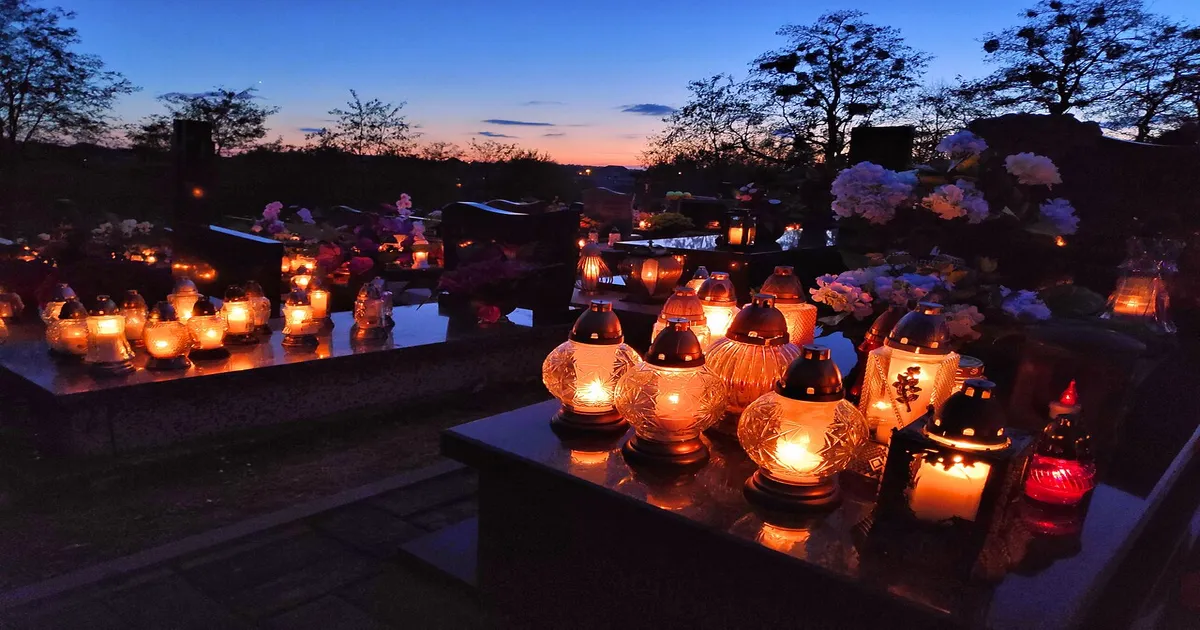
The traditions surrounding Zaduszki (All Souls' Day) and Wszystkich Swietych (All Saints' Day) in Poland have exceptionally deep roots — reaching back to pre-Christian times. Their modern form weaves together Catholic faith, folk rituals and family remembrance in a way unique among European nations. Every year, at the beginning of November, Polish cemeteries transform into seas of flickering grave candles (znicze), while churches fill with the faithful praying for the souls of the departed.
In this article, we explain the difference between the Solemnity of All Saints (1 November) and Zaduszki (2 November), the traditions that accompany these days, what wypominki are, where these customs originated, and how Poles today preserve the memory of their loved ones — including through digital forms of commemoration. Beyond the traditional grave candle at the cemetery, an increasing number of families are creating digital memorials that allow them to remember loved ones throughout the year, regardless of distance.
This article is intended for anyone who wishes to better understand Polish November traditions — both those of faith and those seeking secular ways to honour the memory of the deceased.
All Saints' Day (1 Nov) vs All Souls' Day (2 Nov) — what is the difference?
The Solemnity of All Saints (Uroczystosc Wszystkich Swietych, 1 November) is a Church feast day honouring all saints — and a public holiday in Poland. All Souls' Day, known as Zaduszki or Dzien Zaduszny (2 November), is a day of prayer for the souls of the deceased in purgatory. Although they have different liturgical meanings, in Polish tradition both days merge into a single period of visiting graves and remembering loved ones.
The Solemnity of All Saints — a Church feast day
1 November is one of the most important feast days in the Polish Catholic calendar. The Solemnity of All Saints was established to honour the memory of all saints — both those who have been canonised and the anonymous faithful who attained salvation. On this day, solemn masses are celebrated in churches, and the faithful gather at cemeteries to light grave candles (znicze) and lay flowers on the graves of their loved ones.
Since 1951, the Solemnity of All Saints has been a statutory public holiday in Poland (Act of 18 January 1951 on days free from work, Journal of Laws 1951 no. 4 item 28). This means that most Poles have the opportunity to visit the cemetery — often travelling to their hometowns to stand at the graves of grandparents, parents and other dear ones.
| Feature | All Saints' Day (1 Nov) | All Souls' Day (2 Nov) |
|---|---|---|
| Character | Church feast day (liturgical) | Liturgical commemoration |
| Public holiday | Yes (statutory) | No |
| Purpose | Honouring all saints | Prayer for the souls of the deceased |
| Polish tradition | Visiting cemeteries, candles, flowers | Wypominki, prayers for the deceased |
| Mass obligation | Yes (holy day of obligation) | No (recommended) |
Zaduszki — All Souls' Day, prayer for the deceased
2 November, Dzien Zaduszny (Latin: Commemoratio Omnium Fidelium Defunctorum), is a day devoted to prayer for the souls of the faithful departed who — according to Catholic teaching — reside in purgatory. Unlike the joyful character of All Saints' Day, Zaduszki has a reflective and penitential tone. On this day, special services for the deceased are held in churches, and priests may celebrate up to three masses — an exception to the normal rule of one mass per day.
The tradition of All Souls' Day was formally introduced by Abbot Odilo of Cluny in 998 and spread throughout the Western Church in the 13th and 14th centuries. In Poland, it took root quickly and retains deep significance to this day.
Why Poles treat both days as one
In Polish practice, 1 and 2 November form an inseparable whole. Most families visit cemeteries on 1 November (taking advantage of the public holiday), while prayers for the deceased continue on 2 November. Many Poles do not distinguish between the two observances in everyday speech, using the names "Wszystkich Swietych" (All Saints') and "Zaduszki" (All Souls') interchangeably. This cultural merging of two distinct liturgical celebrations is a uniquely Polish phenomenon — in many Western European countries, 2 November does not carry nearly as strong a tradition as it does in Poland.
Polish November traditions — what we do at the cemetery
The main traditions on 1 and 2 November in Poland are visiting family graves, lighting grave candles (znicze), laying flowers — especially chrysanthemums — cleaning and decorating gravestones, and praying together for the deceased. These customs unite a religious dimension with a deeply rooted sense of family bonds and communal remembrance.
Lighting grave candles — the symbolism of light
The znicz (from the Latin ignis — fire) is the most recognisable symbol of Polish November traditions. Lighting a grave candle for a loved one symbolises remembrance, prayer and hope for eternal life. In Christian theology, the candle's light represents Christ as the "Light of the World" and a prayer for "eternal rest" for the soul of the departed.
Poland is one of the largest consumers of grave candles in Europe. According to the General Association of Polish Candle and Votive Light Producers, Poles buy around 300 million znicze a year — more than any other country in Europe (Rzeczpospolita). After dark, cemeteries present an extraordinary sight — thousands of flickering flames create a sea of warm light that has become one of the most iconic images of Polish culture.
What to know about grave candles (znicze):
- Wax candles burn longer than paraffin ones and are more environmentally friendly
- The size of the candle does not reflect the depth of feeling — even a small znicz is an expression of remembrance
- An increasing number of cemeteries encourage the use of biodegradable candles
- LED candles are an alternative where open flames are prohibited
Chrysanthemums — why this flower
The chrysanthemum is a flower inseparably linked to the Polish tradition of All Saints' Day. Its name comes from the Greek words chrysos (gold) and anthemon (flower). It blooms in November, when most plants have already faded, lending it a symbolic meaning — enduring remembrance that does not fade even as nature dies away.
In European culture, the chrysanthemum has been associated with mourning and honouring the deceased since the 19th century. In Poland, the tradition of laying chrysanthemums on graves is so strong that the flower is almost exclusively associated with cemeteries — in contrast to Asian countries, where the chrysanthemum symbolises joy and longevity.
Which flowers are placed on graves:
| Flower | Symbolism | Popularity on 1 November |
|---|---|---|
| Chrysanthemum | Remembrance, respect, eternity | Very high |
| Heather | Solitude, recollection | High |
| Erica | Enduring memory | Medium |
| Rose | Love, longing | Medium |
| Gerbera | Joy for the life of the deceased | Low |
Cleaning and decorating graves
Preparing a grave before 1 November is an important ritual for many Polish families. In the final days of October, cemeteries buzz with activity — families clean gravestones, rake leaves, plant new flowers and prepare space for candles and arrangements. This shared effort has not only a practical dimension but also an emotional one — tending to a grave is an expression of care for the memory and dignity of the deceased. How to clean the stone safely, what never to use and what year-round grave care costs are covered in a separate guide: grave cleaning step by step.
What to bring to the cemetery:
- Cleaning supplies for the gravestone (water, a soft cloth, a gentle stone-cleaning product)
- Grave candles — znicze (wax or LED)
- Flowers (chrysanthemums, heather, bouquets)
- Matches or a lighter
- Rubbish bags (for old candles and wilted flowers)
- A small rake for leaves (if the grave is surrounded by greenery)
Communal prayer at the cemetery
Prayer at the cemetery on All Saints' Day and All Souls' Day takes both a private and communal form. Many parishes organise processions to the cemetery combined with a devotional service. The faithful recite prayers for the departed — most commonly "Eternal rest grant unto them, O Lord" (Wieczny odpoczynek) and the rosary. The Catholic Church teaches that from 1 to 8 November, a plenary indulgence can be gained for the soul of a deceased person under certain conditions (including visiting a cemetery, praying for the intentions of the Pope, going to confession and receiving Holy Communion).
It is worth noting that the tradition of visiting cemeteries is not limited to people of faith. For many Poles, regardless of denomination or worldview, this is above all a time of family remembrance and reflection on the lives of those who have passed away. Secular funerals (pogrzeb swiecki) and secular forms of commemoration are increasingly accepted and popular in Poland.
Wypominki — prayerful remembrance of the deceased
Wypominki are a Catholic tradition in which the priest reads out the names of the deceased during a service while the faithful pray together for their souls. Families write the names on special slips of paper and submit them to the parish office. Wypominki are one of the most important elements of the Polish Zaduszki tradition, lasting throughout November.
How to arrange wypominki at a parish
The process of arranging wypominki is straightforward, though it varies slightly from parish to parish:
- Prepare a slip of paper — write the names of the deceased (first and last name) for whose souls the family wishes to pray
- Visit the parish office — submit the slip at the parish office (kancelaria parafialna), usually from mid-October through to the end of November
- Offering — traditionally, a voluntary offering is included with the slip (a donation for parish upkeep). The amount is not fixed — it is an expression of gratitude for the prayer, not a "fee"
- Reading of names — the priest reads the names during a special service, most commonly on Sundays in November or on All Souls' Day (2 November)
Monthly and annual wypominki
Polish parishes distinguish between two types of wypominki:
- One-time (monthly) wypominki — names are read in November during All Souls' services. This is the most popular form, used by most families.
- Annual wypominki — names are read throughout the year, usually once a month during Sunday mass. This form ensures regular prayerful remembrance of the deceased.
The history of wypominki — a tradition reaching back to the Middle Ages
The tradition of praying for the dead and reading their names aloud dates to the early Middle Ages. As early as the 10th century, Benedictine monasteries kept Libri memoriales (memorial books) in which the names of deceased founders and benefactors were recorded and read during the liturgy. In Poland, the custom of wypominki spread with Christianisation and remains a living tradition to this day — one of the few that survived both the Partition period and the communist era (PRL).
Roots of the tradition — from pagan Dziady to Christian observances
Polish traditions of commemorating the deceased reach back to the pre-Christian Dziady (Forefathers) — a Slavic ritual of feasting at an ancestor's grave. After the Christianisation of Poland in 966, this tradition did not disappear but merged with Catholic observances of All Souls' Day, creating a uniquely Polish custom that intertwines Christian faith with ancestral remembrance.
Dziady — the Slavic cult of ancestors
"Dziady" (literally "Forefathers" or "Grandfathers") refers both to the spirits of ancestors and to the rituals held in their honour, practised by the Slavs before Christianisation. The rite involved preparing a feast at the grave or in the home, during which food and drink were left for the spirits of the dead. It was believed that on certain days of the year, the boundary between the world of the living and the dead grew thin, and the spirits of ancestors would visit their descendants.
Adam Mickiewicz immortalised these rites in his poem Dziady (1823), describing the ritual of summoning spirits and feeding them on All Souls' Eve. Although the poem is a literary work, it draws on authentic folk traditions from the Vilnius region (Wilenszyzna) and Polesia.
From paganism to Christianity
After the baptism of Mieszko I in 966, the Catholic Church in Poland did not directly suppress the Dziady tradition but gradually replaced it with Christian equivalents. The pagan feast at the graveside transformed into prayer for the souls of the departed, and the belief in ancestral visitations gave way to the Catholic teaching on purgatory and the possibility of aiding departed souls through prayer.
This process of acculturation lasted centuries and resulted in a uniquely Polish tradition in which Christian and pre-Christian elements coexist to this day. Lighting grave candles (light for the spirits), laying flowers (offerings for the dead) and communal visits to cemeteries (a community ritual) — all of these have roots in both the pagan Dziady and the Christian liturgy for the deceased.
Regional traditions
Polish November traditions also have their regional variations:
- Kashubia — "Farmers' Zaduszki" (Chlopski Zaduszek), with food set out on the table for the souls of the deceased
- Podlasie — bonfires lit at cemeteries as "light for the souls"
- Silesia — "Andrzejki" (30 November) as a continuation of the All Souls' period
- Podhale — highland prayers for the deceased "on the mountain peaks" (na wierchach)
Modern forms of remembrance — online candles and digital memorials
Alongside traditional grave candles at the cemetery, an increasing number of Poles are turning to digital forms of remembrance: virtual candles, online memory pages and digital memorials with QR codes on gravestones. These modern forms allow people to remember their loved ones regardless of distance from the cemetery — which is particularly important for the millions of Poles living abroad.
Why digital remembrance is growing in importance
According to Statistics Poland (GUS), around 1.5 million Polish citizens were staying temporarily outside Poland at the end of 2025 (1,513 thousand people absent for 12 months or longer) — most of them in the United Kingdom, Germany and the Netherlands (GUS, published 12 August 2026). For many of them, travelling to their family cemetery for 1 November is impossible or very difficult. Digital memorials — memory pages where photographs, recollections and a life story can be shared — are becoming a way to maintain bonds with ancestors despite physical distance.
Did you know? Modern families are combining tradition with digital memorials. On Kinmory, you can create a memory page with a photo gallery and recollections — accessible to the whole family all year round, not only on All Saints' Day.
QR codes on gravestones
One of the newest ways of combining tradition with technology is QR codes placed on gravestones. After scanning the code with a smartphone, a cemetery visitor can view the deceased person's memory page — complete with photographs, a biography, family recollections and videos. This technology is particularly popular among the younger generation and allows the "story" of the person resting in the grave to be told in a way that a traditional gravestone simply cannot.
Virtual candles and memory pages
The internet now offers many forms of digital commemoration:
| Digital form | Description | Who is it for |
|---|---|---|
| Virtual candle | Symbolic "lighting" of a candle online | People abroad who cannot visit the cemetery |
| Memory page | Profile of the deceased with photos and recollections | The whole family, friends |
| Digital memorial with QR | Physical code on the gravestone linking to an online page | Cemetery visitors |
| Online condolence book | Space for condolence entries | Acquaintances and distant relatives |
These forms do not replace the traditional cemetery visit — they complement it, offering the opportunity to remember loved ones every day, not only in November.
Tradition and modernity — they do not exclude each other
Many Poles combine both forms of remembrance: they visit the cemetery on 1 November, light a candle, lay chrysanthemums — and at the same time maintain an online memory page where they collect recollections from family members scattered around the world. This is a natural evolution of a tradition that has been changing its form for thousands of years while preserving its unchanging essence — the memory of those who have departed.
Frequently asked questions
Is 1 November a public holiday in Poland?
Yes, the Solemnity of All Saints (1 November) is a statutory public holiday in Poland under the Act of 18 January 1951 on public holidays. All Souls' Day — Zaduszki (2 November) — is not a public holiday. It is a regular working day, although many people also visit cemeteries on that day, particularly in the afternoon and evening.
What are wypominki and how do you arrange them?
Wypominki are a Catholic prayer for the deceased in which the priest reads their names aloud in church. To arrange them, write the first and last names of the deceased on a slip of paper and submit it to the parish office (kancelaria parafialna) along with a voluntary offering (donation). Slips are usually accepted from mid-October onwards. Wypominki can be one-time (November only) or annual (read monthly throughout the year).
Why are chrysanthemums brought to cemeteries on All Saints' Day?
Chrysanthemums bloom in November and for centuries have symbolised remembrance and respect for the deceased. Their name comes from the Greek words chrysos (gold) and anthemon (flower). In European culture, and particularly in Poland, the chrysanthemum has become a flower associated almost exclusively with honouring the dead, although in Asian countries it symbolises joy and longevity.
What is the difference between All Saints' Day and All Souls' Day?
The Solemnity of All Saints (Uroczystosc Wszystkich Swietych, 1 November) is a feast day in honour of all saints in the Catholic Church — a day of joy and gratitude for those who have attained salvation. It is a public holiday in Poland. All Souls' Day (Zaduszki, 2 November, Dzien Zaduszny) is a day of prayer for the souls of the deceased residing in purgatory — reflective and penitential in character. In Polish tradition, both days merge into a single period of remembering loved ones.
Summary
- 1 November — the Solemnity of All Saints (Uroczystosc Wszystkich Swietych) is a Church feast day honouring the saints and a statutory public holiday in Poland
- 2 November — All Souls' Day (Zaduszki / Dzien Zaduszny) is a day of prayer for the souls of the deceased in purgatory; it is not a public holiday
- Main traditions: lighting grave candles (znicze), laying chrysanthemums, cleaning graves, communal prayer at the cemetery
- Wypominki are the reading of the names of the deceased in church — a tradition dating back to the Middle Ages, arranged through the parish office
- The roots of Polish Zaduszki reach back to the Slavic Dziady — a pre-Christian ritual of honouring ancestors
- Modern forms of remembrance: digital memorials, online memory pages and QR codes on gravestones complement the traditional cemetery visit
- November traditions unite people of faith and those without — above all, this is a time of family remembrance
Related articles
- Catholic funeral — the ceremony and traditions — a detailed description of a Catholic funeral in Poland, including the funeral mass, funeral procession (kondukt zalobny) and memorial meal (stypa)
- Grief after the loss of a loved one — stages and support — how to cope with grief, the stages of the grieving process and where to find psychological support
- Death anniversary — how to honour the memory of a loved one — how to honour a death anniversary with dignity, anniversary masses and other forms of remembrance
- Digital memorial and QR code on a gravestone — modern remembrance — how a digital memorial works, how to order a QR plaque for a gravestone and what can be included on a memory page
- Grave cleaning step by step — how to clean a gravestone and what grave care costs — safely cleaning granite, marble and terrazzo before 1 November, plus the price list for ongoing grave care
- How to find a grave in Poland — search engines, cemetery registers and archives — grave search engines, cemetery records and state archives when you do not know where a relative is buried
A memorial always within reach
A memory page on Kinmory is available every day — family members can remember, share photos and light a virtual candle. Create a digital memorial on Kinmory — gather photos, videos and the life story of your loved one in one place.